

Coronavirus live news: China reports 69 new cases; Vietnam limits flights for lunar new year | World news
02:26
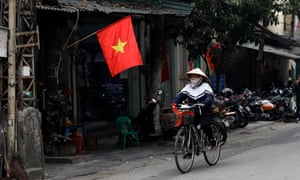
Vietnam limiting flights for Lunar New Year
Vietnam will limit flights bringing citizens home from now until the end of the Lunar New Year in mid-February, when big gatherings indoors are expected, to reduce coronavirus risks, the country’s prime minister said.
With a new Covid-19 variant spreading around the globe and the upcoming Lunar New Year, the country’s most important holiday, only necessary flights approved by health, foreign, defence, public security and transport ministry are allowed to enter the country, Prime Minister Nguyen Xuan Phuc said.
After the Lunar New Year, which falls on February 10-16, the transport ministry will study the possibility of international flights resumption, Phuc added.
Vietnam has suspended all inbound international commercial flights since late March, but the government has been operating repatriation flights to bring home Vietnamese citizens stuck abroad amid the pandemic.
Some special flights carrying foreign experts and investors have been allowed to fly into Vietnam. All people entering the country have to spend 14 days in quarantine. The country on Tuesday suspended inbound flights from countries with new Covid-19 variants, initially Britain and South Africa.
Thanks to strict quarantine and tracking measures, Vietnam fared much better than many nations, registering a total of 1,513 coronavirus infections and 35 deaths. It has gone 38 days with no locally transmitted cases. (Reuters)
Updated
02:10
01:47

Residents on Sydney’s northern beaches have welcomed the end of a tough three-week lockdown and praised the “amazing” community solidarity that helped avert a disastrous outbreak.
The past three weeks proved an immense challenge for the northern beaches, particularly the northernmost zone. The lockdown ruined Christmas holiday plans and robbed local businesses of revenue during their busiest trading period.
“It’s the sense of time, it slips away – you’re just one day to the next,” Libby Armstrong, the owner of Beachside Bookshop in Avalon told the Guardian on Sunday.
01:16
01:05
Germany records almost 17,000 new cases
00:44
Thousands of Israelis on Saturday renewed weekly demonstrations against Prime Minister Benjamin Netanyahu, calling for the long-serving leader to resign over corruption charges against him and his alleged mishandling of the coronavirus crisis.
Protesters held signs reading “Go,” and “Bibi, let my people go,” referring to Netanyahu by his nickname.
The protest in a Jerusalem square near Netanyahu’s official residence comes as Israel is the midst of its third national lockdown, which was recently tightened to shutter schools, and as the country presses forward with a world-leading vaccination drive. Netanyahu’s trial was set to resume this week, but was postponed indefinitely amid the tighter restrictions.


Netanyahu has been indicted on charges of bribery, fraud and breach of trust connected to three long-running investigations. He has denied any wrongdoing and says he is the victim of a “witch hunt” by hostile media, law enforcement and judicial officials. Protesters argue that Netanyahu cannot properly lead the country while under indictment.
Israel has seen a recent surge in cases despite unleashing one of the world’s fastest vaccination campaigns. The country has given the first of two vaccine doses to nearly 20% of its population, and Netanyahu said Thursday that Israel has secured enough vaccines to inoculate the whole adult population by the end of March.
Netanyahu has placed the vaccination drive at the centre of his campaign for reelection that same month. On March 23, Israel will hold its fourth nationwide vote in less than two years. In the meantime, he has called on Israelis to make “one last big effort” to halt transmission by adhering to the tightened restrictions. (AP)
23:58
23:31
Monday marks the anniversary of China confirming its first death from Covid-19, a 61-year-old man who was a regular at the now-notorious Wuhan wet market, writes AFP.
Nearly 2m deaths later, the pandemic is out of control across much of the world, leaving tens of millions ill, a pulverised global economy and recriminations flying between nations.
Yet China, which has broadly controlled the pandemic on its soil, is still frustrating independent attempts to trace the virus’s origins and the central question of how it jumped from animals to humans.

There is little dispute that the virus which brought the world to its knees sparked its first known outbreak in late 2019 at a wet market in the central Chinese city of Wuhan where wildlife was sold as food, and the pathogen is believed to have originated in an undetermined bat species.
But the trail ends there, clouded by a mishmash of subsequent clues that suggest its origins may predate Wuhan as well as conspiracy theories – amplified by US president Donald Trump – that it leaked from a Wuhan lab.
Establishing the source is vital for extinguishing future outbreaks early, leading virologists say, providing clues that can guide policy decisions on whether to cull animal populations, quarantine affected persons, or limit wildlife hunting and other human-animal interactions.
“If we can identify why [viruses] keep emerging, we can reduce those underlying drivers,” said Peter Daszak, president of EcoHealth Alliance, a global NGO focused on infectious disease prevention.
Updated
22:56
Updated
22:40
Updated